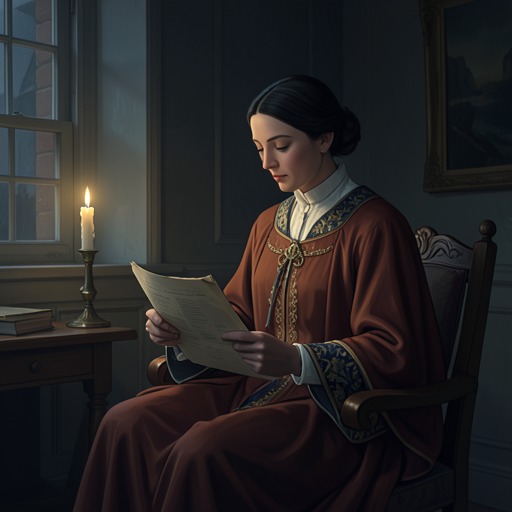
The sleeping princess
The Constant PrincessThe sleeping princess is the image Catalina of Aragon uses to make her long isolation in England legible: she is not simply waiting for events to change, but feels suspended in a cold, diminished life from which she may never awaken. The metaphor gathers her material hardship, lost agency, homesickness, and emotional estrangement into a single figure, then sharpens into the image of a princess made of snow.
Origins in isolation
Catalina first compares herself to a sleeping princess while describing life on the fringe of Henry VII of England’s court. Her allowance has stopped, she has no money of her own, and the Spaniards who remain in her household are there because they cannot leave. The years pass as they grow older and more resentful; Catalina imagines herself asleep in a fairy tale, with no prospect of waking. The image gives a personal shape to a condition maintained by dependence and exclusion rather than by any literal enchantment.
The metaphor follows a sequence of losses. Catalina has lost the confessor appointed by her mother, the ladies who cannot endure poverty, and her house on the Strand, which had been a rare safe place in a foreign land. Even María de Salinas’s steadfast companionship, sustained through love, stands out against the departures around them. The sleeping princess is therefore not merely idle: she has been stripped of the household, resources, and daily relationships that might have made action possible.
The winter image
The image becomes bodily and seasonal in Catalina’s account of the English winter. In April, frost still covers the grass in the morning; ice forms on her bedroom windows, the water by her bed freezes by midnight, and her household can no longer afford to keep a fire burning through the night. Walking outside, she feels the cold through the thin soles of her boots. Against this immediate chill she sets her longing for the burning heat of Spain, imagining that its warmth might bake her despair away. She describes the seven years of waiting as a cold that has settled into her life, and fears that without warmth she will melt away like rain or river mist.
That contrast gives the snow-princess image its force: cold is both an actual feature of her impoverished surroundings and a figure for emotional depletion. Catalina does not present herself as yielding to grief in the same way she fears her sister Juana has done. Instead, she says her determination to be queen has turned her to stone. The sleeping princess has become a princess of constant snow, preserved in resolve but cut off from feeling.
Waiting for a future that may not come
The fairy-tale suspension also shapes Catalina’s view of what may happen next. If the court’s report that Henry VII is dying proves true, and Harry Tudor becomes king and marries Eleanor, Catalina plans to ask her father for permission to enter a convent. She sees retreat as no poorer, colder, or lonelier than her present life. Her contemplated withdrawal is conditional, not an event that the passage confirms; it shows how narrow she believes her remaining choices have become.
In the same moment, the prospect of a convent carries a deeper sense of abandonment. Catalina believes her father has forgotten his love for her and given her up as though she had died with Arthur, Prince of Wales. She acknowledges wishing each day that she had died with him. The sleeping princess’s hoped-for awakening has thus become uncertain: the future she once organized around being queen now competes with the desire to escape a life she can scarcely bear.
Numbness, faith, and what remains
Catalina distinguishes her condition from despair. She has sworn not to despair, but says the ice in her heart feels instead like lost feeling: her determination has hardened her, leaving her unable to experience herself as either surrendering or emotionally alive. This distinction makes the snow image more than a sign of sadness. It describes a self-protective stillness that has become painful in its own right.
Her numbness reaches into her religious life. Catalina can no longer sense God’s presence or take comfort in being specially chosen, whether for blessing or for testing; she fears that God has turned away from her as her earthly father seems to have done. Yet the passage does not make her entirely empty. She still loves Arthur, a surviving warmth she imagines as a small, beating heart fallen from a frozen sky, and still longs for Spain, the Alhambra Palace, and al-Yanna as a secret garden and paradise. These remaining attachments complicate the image of the sleeping princess: she is cold and isolated, but love and homesickness endure beneath the ice.